Interior Lives
The Two Sycamores art collection is anchored by two works by artists of Scotland: Sir William Quiller Orchardson (March 27, 1832 – April 13, 1910) and John Pettie Scotland.
Formed within the Royal Scottish Academy and sustained by parallel London careers, Orchardson and Pettie maintained a lifelong friendship that reinforced their shared commitment to narrative restraint and moral seriousness, psychological density, and ethical ambiguity. What unites the Two Sycamores paintings is not subject matter or nationality, but method: the conviction that meaning emerges most forcefully when spectacle is refused.
At the center of this system stands Orchardson’s Jessica (exhibited at the Royal Academy, 1877). The painting occupies a threshold position not only in the pairing, but within Orchardson’s own career. Jessica is generally understood as his final sustained engagement with Shakespearean subject matter, marking the moment at which literary narrative gives way to a self-sufficient psychological method.
Although derived from The Merchant of Venice, Jessica (Shylock’s daughter) deliberately evacuates Shakespearean dramaturgy. Plot, action, and moral resolution are withheld. Orchardson does not illustrate a scene; he isolates a determinative moment. Jessica stands at the drapery in a state of moral hesitation—stripped of anecdote, theatrical cue, or explanatory gesture. Gesture is minimized, expression restrained, and narrative context reduced to its barest necessity. What remains is interior pressure.
This discipline is not incidental, nor is it confined to Jessica. Throughout Orchardson’s broader practice, decisive action is conspicuously absent. In later works such as Marriage de Convenance, The First Cloud, and Hard Hit, Orchardson abandons literary frameworks altogether, yet the psychological logic introduced in Jessica persists. Social obligation, emotional consequence, and ethical uncertainty are conveyed through posture, distance, and silence rather than event. Seen in this light, Jessica is not transitional but foundational: the point at which Orchardson extracts from Shakespeare a language of restraint that becomes self-sufficient.
In Jessica, Orchardson establishes the collection’s governing principle. Narrative painting achieves its greatest force not through declaration or climax, but through unresolved moral space. The viewer is required to remain with the figure—to read stillness as evidence of thought rather than absence of meaning.
Orchardson’s close friend John Pettie enters a related interior moral space in Eugene Aram and The Scholar (exhibited at the Royal Academy in 1882). Although inspired by Thomas Hood’s The Dream of Eugene Aram, Pettie does not dramatize crime or remorse. Instead, he presents knowledge itself as burden. Aram is not rendered as a sensational criminal, but as a consciousness weighed down by ethical awareness. Pettie’s figures are not actors within narrative; they are inhabitants of consequence, isolated not by circumstance but by understanding.
In this way, Pettie advances Orchardson’s restraint into ethical weight. Where Orchardson suspends decision, Pettie accepts its cost. Together, the two paintings articulate a shared belief that interior life—hesitant, burdened, unresolved—is not secondary to narrative meaning, but its deepest form.
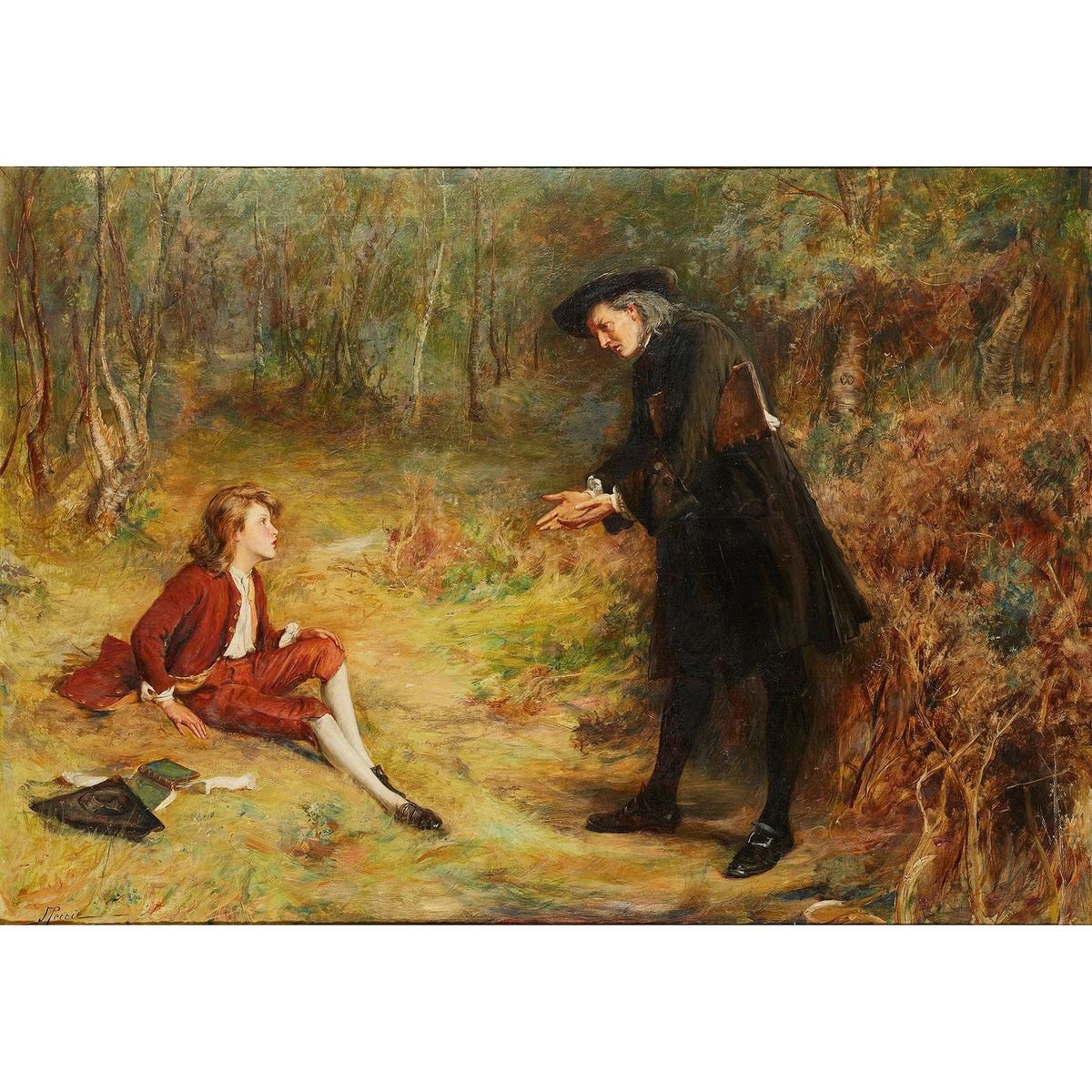
Exhibited at the Royal Academy, 1882.
“And he spoke with him of Cain.” — John Pettie, R.A. — (Scotland, March 17, 1839 – February 21, 1893). See Thomas Hood’s ‘Dream of Eugene Aram’.
