Silk Quality.
Matters of Fine Fabric Adulterations
The Huntington Texilscope is an early 20th-century British electroscope designed for the non-destructive examination of fabrics, particularly silk, wool and linens. It was invented by Dr. H. T. Scott-Hunting and publicly exhibited in at the Palace of Engineering, British Empire Exhibition (1924) at Wembley, London.
The instrument forms part of the wider movement toward scientific quality control in textile manufacturing during the interwar period and the acclerating use of synthetic fibers in mass-market manufacturing.
Invention and development
Contemporary documentation identifies Huntington as a British scientist active in the early 1920s and residing in Harrow, Middlesex as both the inventor and patentee of the device.
The Texilscope operates on principles of electrostatic response, with movement of internal gold metal leaves providing qualitative indications of fiber composition and condition.
Designed to be portable and appeal to an interested public it also was also very attractive to the general trade and emerging textile manufacturing markets.
This example has survived complete with its orignal wood transport case and instructions pamphlet which is transcribed here.
READ CAREFULLY
The “TEXILSCOPE” is a small and portable scientific instrument intended (apart from the tailor, merchant and draper) mainly for the public, to be carried in one’s pocket, enabling one to distinguish the purity, mixture artificiality or adulteration of woollen, silkens, cottons, linens, fur, human, goat or camel hair and feathers, in the presence of one’s tailor or merchant: also of wax, rubber or insulating materials.
As humidity affects the proper functionment of the “TEXILSCOPE,” it is advisable, especially if you receive it in cold or damp weather, to remove it from its case and at once place it near an electric light bulb or other DRY-HEAT radiating surface for several minutes to “dry-it-out”. Thereafter, “KEEP IT DRY” and CLEAN may explain all the attention it will ever require.
TO CHARGE THE ‘TEXILSCOPE
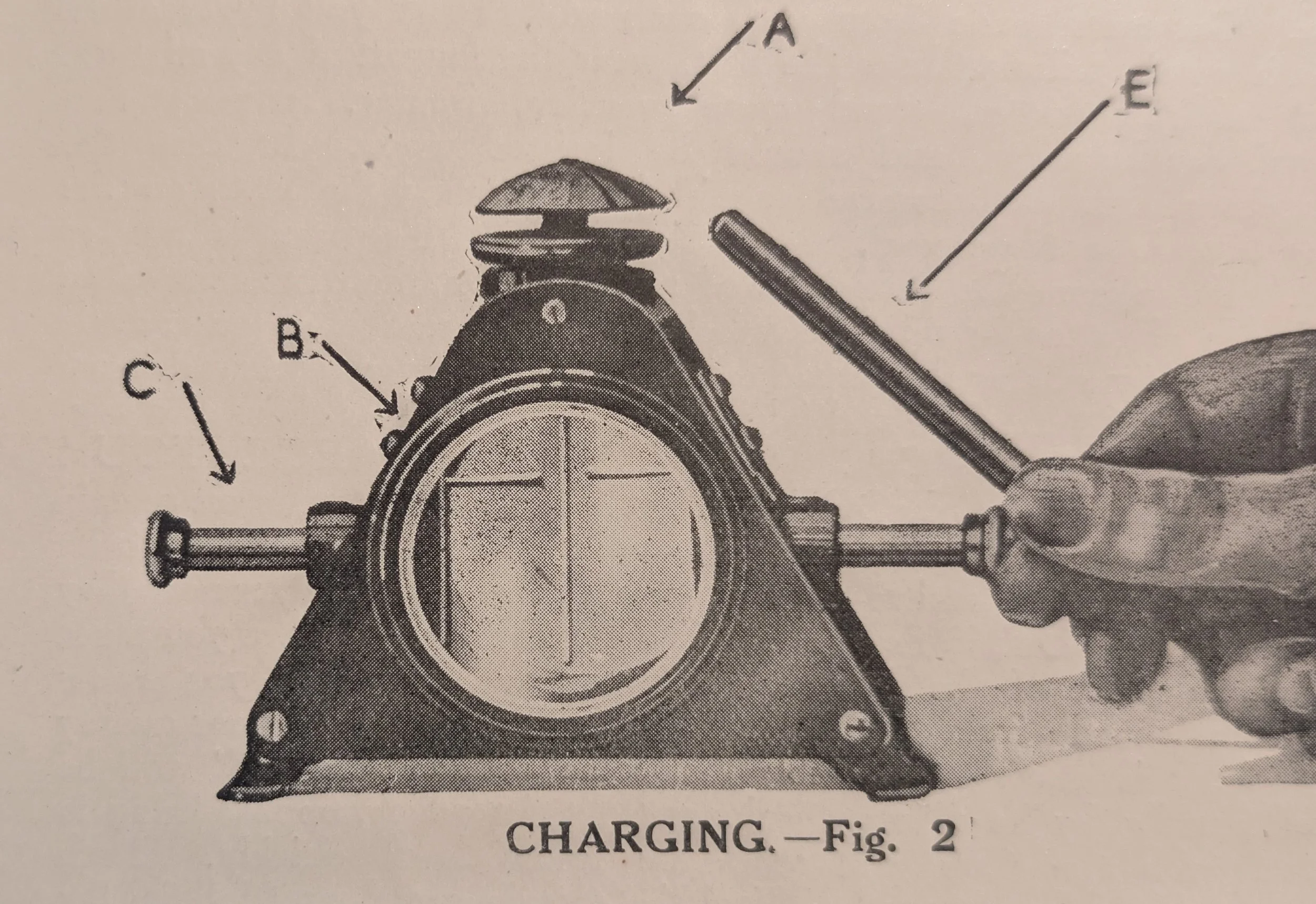
Drawing from the Huntington Texilscopes product literature, 1924.
Grasp one of the plungers, C in each hand and slide them outwards to THEIR FULL EXTENT. Hol the charging tube within ouyr left palm, then grasp the charging stick, E, between the index and thumb of your right hand, near its end. Hving made certain that the Detecting-Cup, A, is free from the smallest particle of anything, briskly rub your stick within the felt lining of the tube several times. This will heat it and generate a static charge around it. The, withdraw it and quickly apply it to the RIM (not the top) of the Cup and, while maintaining an oblique position of that stick, without the slightest hesitation slide it downwards quickly until its point snaps away from the Cup’s RIM. You will now observe the two delicate metallic arms, B-B, which are the indicating means for your tests, to have rissen and assumed a rigidly hoirizontal position. In case you experience that these arems have a tendency not to bedome rigid, it means youyr charge is too weak: or, if the arms jump up and down rapidly, it means you have the arms too near the magnet, and they are touching: or, if the arms appear to droop somewhat instead of assuming that rigidly horizontal position, slowly push inwards the plungers until you observe the tips of the arms are within two millimeters (about 1-16th inch) from the attractor, when it will be noticed the arms assume greater rigidity: or, if the arms do rise to their position, but do not retain it for several minutes, it means the instrument has been lfet where it is damp, so dry it by placing it near some dry-heat radiating surface. If one of the arms does not rise, it means you were careless in closing it, after a previous test, in not observing that your delicate arms were in their respective beds VERY FLAT. This is essential, otherwise you will break them. In case one of the arms appears to be stuck upon its plate, approach it towards the charged attractor, A, which charge will soon “draw” it away. That was due to your not being careful to have it in its bed FLAT after using it previously.
As we are still able, Two Sycamores is continuing it’s research on this item. Soon to be added is more of the 1924 document’s details on how to operate a Texilscope on various fabrics. You are invited to contact us with information on this item from your expert position.
